
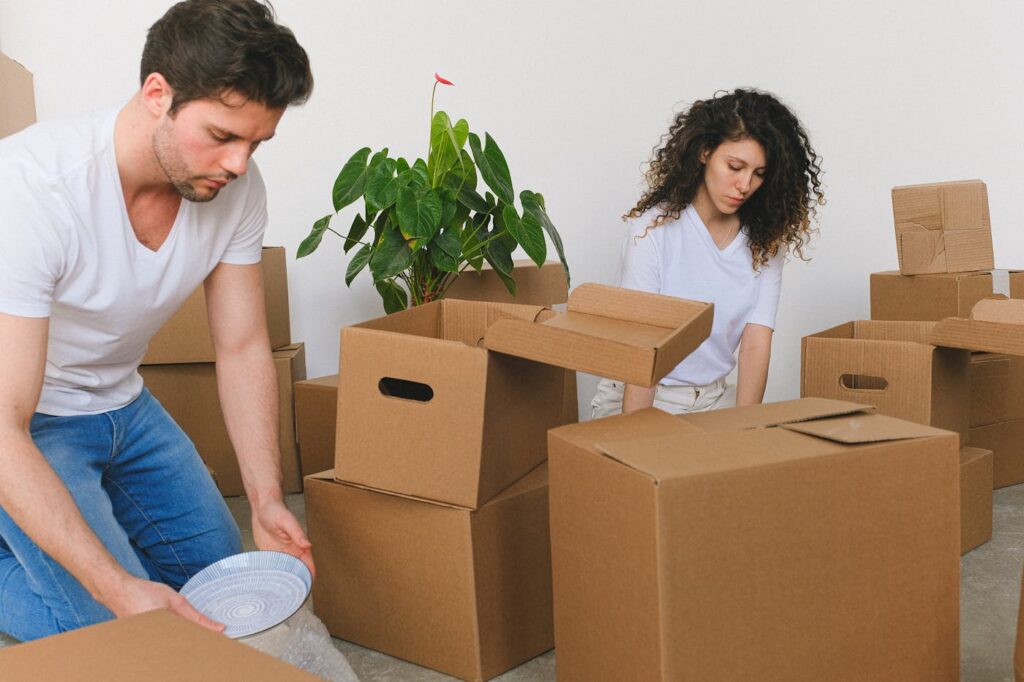
Packing advice written for the rest of the country skips the two facts that govern South Florida: the air is wet, and from June through November the schedule itself can move. Crews from Three Friends Moving have loaded thousands of households across Palm Beach County since 2012, and the gap between a two-hour unload and a five-hour one is almost always created weeks earlier, at the packing stage. Here is the room-by-room system we recommend, adjusted for this climate.
Start with one supply run, sized to your home
Running out of tape at midnight is a self-inflicted wound. Buy everything at once, using this as a baseline:
| Home size | Small boxes | Medium | Large | Dish packs | Wardrobe boxes |
|---|---|---|---|---|---|
| Studio (a downtown 33401 unit) | 10 | 12 | 6 | 2 | 2 |
| One-bedroom | 15 | 20 | 10 | 3 | 3 |
| Two-bedroom | 25 | 30 | 15 | 4 | 5 |
| Three-bedroom house | 35 | 45 | 20 | 6 | 7 |
Add two more rolls of tape than feels reasonable, a marker for every person packing, and a roll of stretch wrap. Skip free grocery-store boxes: in this humidity, cardboard that has spent a few damp nights behind a supermarket loses half its strength, and a bottom letting go in a stairwell costs more than new boxes ever would.
Florida rules that apply to every room
- Paper before plastic on wood. Stretch wrap applied directly to a dresser traps moisture against the finish; pad the piece with paper or a blanket first, then wrap.
- Drop a silica packet into boxes of electronics, photographs, and books.
- Candles, vinyl records, crayons, and anything else with a low melting point ride in your air-conditioned back seat, not in the truck box.
- Leather needs to breathe. Cover chairs and bags with cotton sheets rather than sealed plastic.
- Stage boxes off the floor if they sit overnight in a garage or on a lanai; concrete wicks moisture straight into cardboard.
Room by room, in the order that works here
Week one: lanai, garage, and storage closets
Begin with the spaces you will not miss. Patio furniture gets a wipe-down before wrapping, because the salt film that builds up near the water transfers onto everything it touches in the truck. The grill travels only after the propane tank comes off and stays behind; no mover can legally carry fuel, and the same goes for gasoline in trimmers and generators, paint thinner, and pool chemicals. Use those up or give them to a neighbor. Holiday bins, luggage, beach gear, and sports equipment all box up now.
Week two: the home office and the paper layer
Files go in small boxes only; a large box of paper is unliftable. Photograph the cable arrangement behind the desk, then flag each cord with masking tape before unplugging anything. Passports, deeds, tax records, and backup drives go into one tote that never touches the truck. It stays with you in the car, because if a closing date slips, those are the items you cannot wait a week to recover.
Week three: kitchen wave one, bathrooms, and books
The kitchen eats more hours than any two other rooms combined, so split it in half. Wave one covers what you will not need before the move: serving platters, the stand mixer, holiday dishes, pantry overstock. Plates pack vertically in dish boxes with paper between each one; stacked flat, they absorb every bump. Each glass gets its own paper wrap and a slot in a divided insert. In the bathrooms, liquids go into a plastic bin rather than cardboard, because one leaking shampoo bottle inside a hot truck finds everything. Towels and linens become free padding for whatever needs it.
The final week: bedrooms, kitchen wave two, and the living room
Hanging clothes transfer straight from closet rod to wardrobe box. Dressers can keep their light contents if we are doing the carrying; tell the crew and they will wrap the piece accordingly. Every person in the house packs an open-first box: sheets, a towel, chargers, toiletries, and two days of clothes. Kitchen wave two happens in the last 48 hours: everyday plates, the coffee maker, one pan. Televisions go back into original cartons if you kept them; if not, we bring padded TV boxes on move day. Mirrors and framed pieces stand on their edges in picture boxes and lean against a wall until loading. Glass that travels flat collects the weight of everything stacked above it.
Number the boxes, skip the poetry
- Give every box a number and keep one running list on your phone: number, room, and a three-word summary of contents.
- Write the room and the number on two sides of the box rather than the lid, which disappears the moment anything is stacked.
- Star the boxes you will need in the first 24 hours so they load last and come off first.
- Photograph the contents of any box worth more than a paycheck before sealing it. If a claim ever happens, that photo does the arguing for you.
The packing mistake we see most in Palm Beach County is not bad wrapping, it is timing. People underestimate the kitchen by a full day, every single time. Start it a week early, in two passes, and the rest of the move follows the plan. — Cody Brennan, co-founder
Packing for a condo or high-rise move
If your move starts or ends in a tower on Singer Island, in downtown West Palm Beach, or over on the island of Palm Beach, pack to the building’s rhythm. Keep individual boxes under fifty pounds and uniform in size, because everything rides four-wheel dollies through a service corridor, and odd shapes waste elevator trips. Stage finished boxes in stacks by the door; the reserved freight-elevator window is finite, and a crew that spends it hunting through rooms is burning your reservation. Your association will also want a certificate of insurance before the crew arrives, which we handle as part of booking.
Leave these out of the boxes entirely
- Propane, gasoline, aerosols, paint, and pool chemicals. None of it may ride on the truck.
- Jewelry, cash, passports, and medication. These travel with you.
- Houseplants in summer. An afternoon inside a closed truck at Florida temperatures is fatal to them.
- Open food and anything refrigerated.
Quick answers
How early should packing start?
Four weeks for a house, three for an apartment. Lanai, garage, and storage closets go first; the everyday kitchen goes last.
Can you do the packing instead?
Yes. Full and partial packing can be added to any written estimate, and our crew brings the dish boxes, paper, and wardrobe boxes with them.
What does it cost to have movers pack just the kitchen?
Typically one to two hours of added crew time at the standard rates of $130 to $225 per hour depending on crew size. The exact figure goes into your written estimate; see the cost guide for how labor is calculated.
Do pianos need special packing?
No boxes, but plenty of padding and the right equipment. Our own crew moves uprights for $320–$480 and baby grands for $520–$800, board-wrapped and strapped, never improvised.
Rather skip the tape gun altogether?
Add full or partial packing to your move and our West Palm Beach crew handles every room on this list. Call (888) 711-4778 or start online.